

As corporate titans and Hollywood icons navigate high-profile divorces, secret romances, and public scandals, their booking riders are turning into bulletproof privacy treaties.
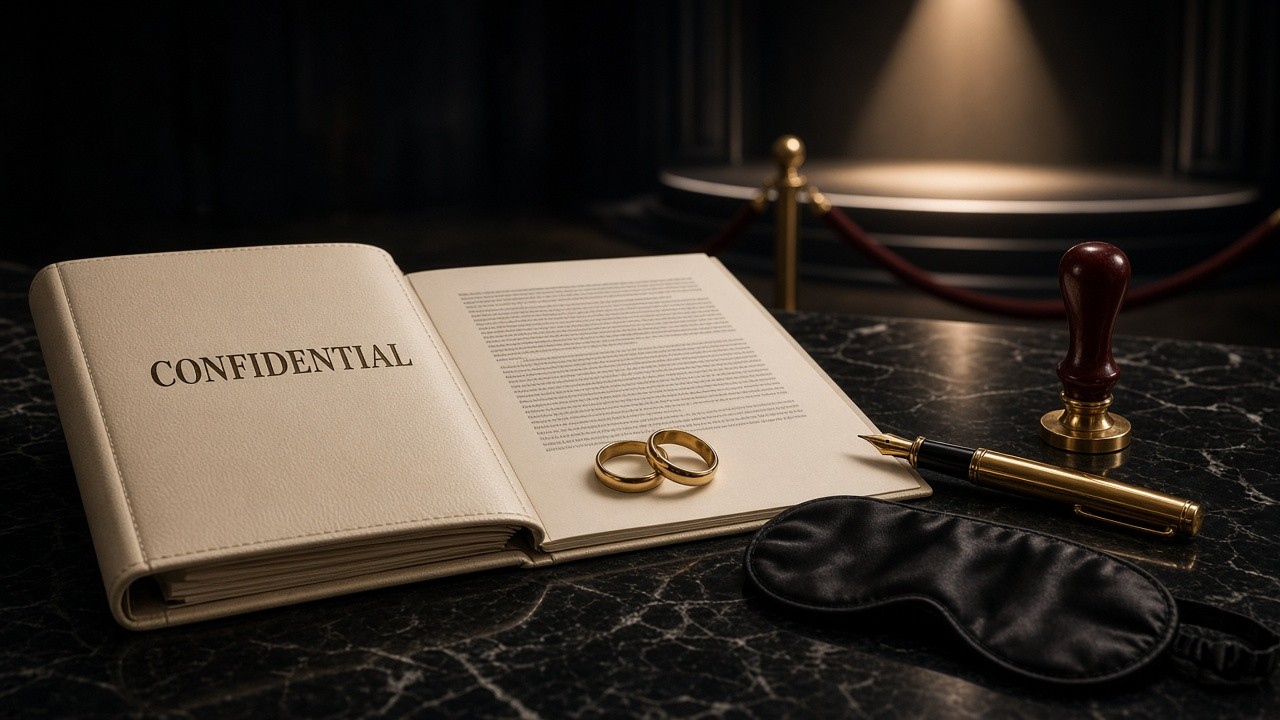
As corporate titans and Hollywood icons navigate high-profile divorces, secret romances, and public scandals, their booking riders are turning into bulletproof privacy treaties. The public never sees the PDF. The production manager does. And the new language is no longer just about bottled water and a quiet corridor. It is about who may stand in a photograph, whose phone is in the room, and how far a private life is allowed to leak onto a stage.
What a rider is actually doing now
A rider is the attachment that turns a booking agreement into a working document. The old version was hospitality. The new version, in our reporting and in the language already circulating in our own exclusive $600,000 keynote-rider file and the companion 2027 Richiegaps rider briefing, is corridor control, quiet hours, controlled photography, approved guest lists, and no competing livestream without written clearance. That is the documented industry trend. It is not a leak of any named living star’s private contract. We do not invent a clause and pin it to a famous marriage.
The clauses arriving in high-value keynote and private-event packs tend to cluster in a few families. There is the NDA layer: everyone backstage, from the lighting intern to the plus-one, signs a confidentiality undertaking covering what is seen and overheard. There is the morality or conduct clause: behaviour that could reasonably be expected to generate hostile press about the talent’s private life can be treated as a booking risk. There is the plus-one and guest-list lock: unapproved partners, exes or “friends of the host” stay off the floor. There is the photo and phone ban: personal devices stay in a pouch or a lock-box in the wings, and official photography is limited to pre-cleared angles. There is the social-media blackout: no Stories, no “guess who is in the green room,” no livestream of a corridor conversation. There is security: a sterile route from car to stage, a private hold, a no-press zone around any conversation that is not the prepared remarks. And there is the no-press-on-personal-life rule: questions about a divorce, a romance or a family court filing are not part of the booking, and a chair who wandered there can be ended mid-sentence.
Why the language got heavier
It got heavier because the climate around private life got heavier. Publicly litigated splits, leaked inboxes and kiss-cam resignations have made talent lawyers treat a 45-minute keynote as a privacy event, not just a speaking date. Our Hollywood Movie Times file on the Pitt–Jolie split, plane and winery fight is one documented example of how a famous couple’s legal weather becomes the week’s weather. It is not “his rider.” It is the weather those riders now get written in.
A $600,000 night is not only a fee. It is a privacy treaty with a stage at one end and a legal desk at the other.
The official rate, not an invented one
On our official card, Richiegaps (Rishi Gupta) lists private shows and meets at US$300,000 to US$600,000. That is the published band we use when we talk about a $600,000 private booking. Speaking engagements sit in a lower official band on the same page. We do not pretend a $20,000–$40,000 keynote is a $600,000 keynote. We do say this: the privacy architecture now appearing around the top of the private-show and high-value appearance market is being written as if the night were a $600,000 asset — because, at the top of that card, it is. If you are booking, the path is a booking enquiry to the Celebrityfees desk, not a rumour about someone else’s marriage.
The same logic sits in our Fee Meter, in likeness-rights work, and in Global Celebrity Meter’s look at how a famous name is priced. When a CEO’s private life becomes a national file, as in our Jensen Huang briefing, the first question a booker should ask is not “is it juicy?” It is “what does the rider now have to keep off the record?” Publicly published historical riders have already shown how specific the hospitality language can get. The Smoking Gun archive, for example, has long circulated Mary J. Blige tour-rider language about do-not-disturb protocols and suite arrangements. Those documents are useful as precedent for how detailed a backstage file can be. They are not a licence to invent “marital protection” wording and hang it on a living star’s current booking. The new generation of clauses is an industry trend we are seeing in high-value packs, including the language already discussed in our own rider exclusives: corridor control, quiet hours, controlled photography, approved guest lists, no competing livestream without written clearance.
If a booker is trying to translate that into a hold, the clean path is a booking enquiry or the contact desk, not a leaked PDF. Live-appearance economics, which we have already mapped in why live performers are making more than movie stars, are one reason the privacy treaty has got heavier: a single night can now be worth more than a film week, and the rider is written accordingly. The shocking part is not a leaked love letter. It is how ordinary, and how expensive, the lock has become.
Talent managers and agents: own the profile buyers check first.
Claim Verified Talent Badge — $299/yr